Reviewed and updated 3 September 2026. General owner education, not individual legal, veterinary or behaviour advice.
UK territory comparison
| Territory | Core position | Where to verify |
|---|---|---|
| England | Valid exemption required; muzzle and lead in public; secure keeping. | England guide |
| Wales | Same central framework as England; local council services differ. | Wales guide |
| Scotland | Scottish exemption index; muzzle and lead in public; secure keeping. | Scotland guide |
| Northern Ireland | Valid exemption plus annual dog licence; council-led administration. | Northern Ireland guide |
The common rules
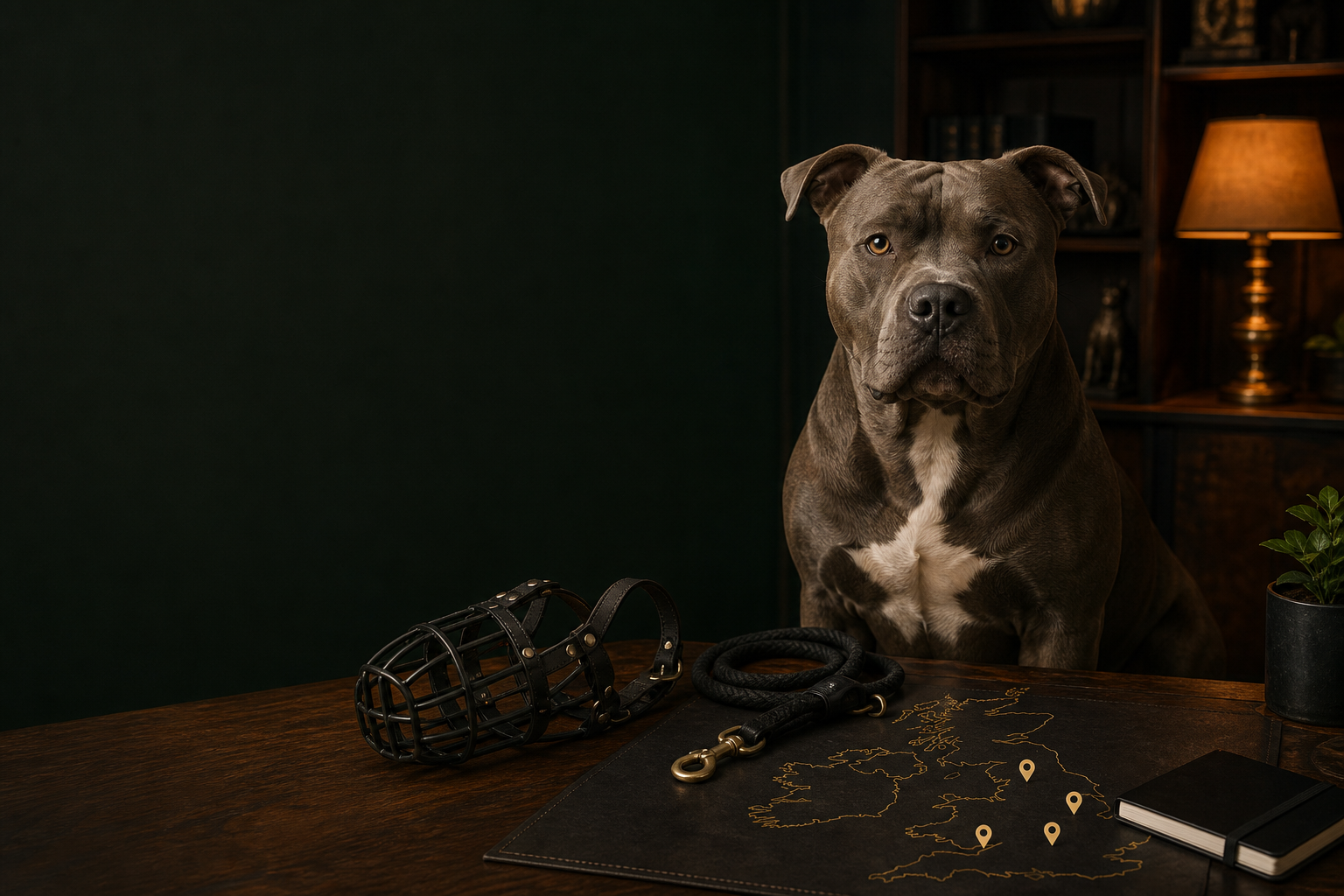
Across the UK, owners must not breed, sell, give away, exchange or abandon an XL Bully. An exempt dog must be kept securely so it cannot escape. In public it must wear a suitable muzzle and be on a lead securely held by a person aged 16 or over. Address, microchip, neutering and certificate records must remain accurate.
Insurance changed on 1 July 2026
Official guidance for England and Wales, Scotland and Northern Ireland now says third-party liability insurance is no longer a condition. Do not rely on an old checklist that still describes insurance as compulsory.
The 1 November 2026 child-supervision condition
This condition starts on the same date across the UK, but the official wording is not identical and should not be treated as a single UK-wide sentence. Scotland states a minimum age for the supervising adult and frames the condition around any prohibited type; England, Wales and Northern Ireland use "close contact" wording with no stated adult age.
| Territory | Official wording | Supervising adult | Applies to |
|---|---|---|---|
| England and Wales | You must not leave a child under 12 in close contact with an XL Bully dog in a private place (for example a home or garden), without adult supervision. | No minimum age stated | XL Bully dogs |
| Scotland | Children under 12 must not be left alone with any prohibited type dog in a home or private place. Guidance states an adult aged 16 or over must be present whenever a child under 12 is with an XL Bully dog. | Aged 16 or over | Any prohibited type dog |
| Northern Ireland | You must not leave a child under 12 in close contact with the dog in a private place (for example a home or garden), without adult supervision. | No minimum age stated | Exempted XL Bully dogs |
Whichever territory you are in, the safest reading is the strictest one: an adult present, aware and able to intervene. Good practice is to implement this immediately through barriers, adult handovers, sleeping arrangements and explicit family rules rather than waiting for November. Our full guide to the 1 November 2026 rule covers building a household routine that holds.
Moving or travelling between territories
Do not assume that a certificate, temporary address allowance or administrative process works identically after a permanent move. Contact both the authority you are leaving and the authority responsible for the destination before changing address. Keep the dog compliant in public throughout the journey.
Official sources
Legal information checked against official government guidance on 3 September 2026. Rules can change and individual cases differ. This is general information, not legal advice.
Frequently asked questions
Are the XL Bully rules identical everywhere in the UK?
The core restrictions are very similar, but administration differs. Northern Ireland also requires a current annual dog licence.
Can I still apply for an exemption?
Ordinary application windows are closed. Court-authorised routes may exist in limited cases, so obtain local legal advice.
Did the insurance rule change?
Yes. Official guidance says third-party liability insurance stopped being a condition from 1 July 2026.