Safety & Law
XL Bully Child Supervision Rule from 1 November 2026: What Owners Must Do
The rule, plainly
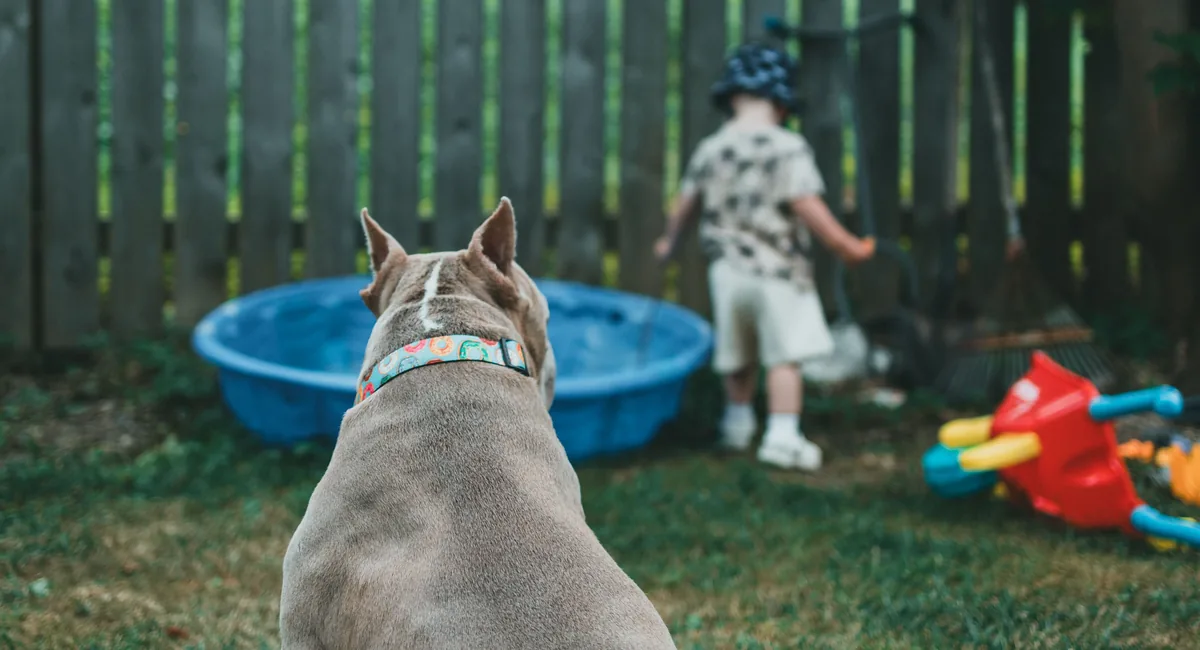
From 1 November 2026, a child under 12 must not be left with an XL Bully dog in a private place — such as a home or garden — without adult supervision. The condition starts on the same date in England, Wales, Scotland and Northern Ireland, but the official wording is not identical in each.
In England, Wales and Northern Ireland the wording is that you must not leave a child under 12 in close contact with the dog in a private place without adult supervision, and no minimum age is stated for the supervising adult. In Scotland the guidance goes further on two points: it says an adult aged 16 or over must be present, and it frames the condition around any prohibited type dog rather than XL Bully dogs alone.
This is a condition of exemption. It does not prevent an XL Bully living in a household with children. It requires that an adult is present and supervising.
Scope: legal information, not legal advice, and not a behavioural assessment of your dog. Each territory's wording was checked against its own official page on 15 August 2026.
Where this sits among the 2026 changes
| Date | Status | Change |
|---|---|---|
| 1 July 2026 | In force | Third-party public liability insurance is no longer required as a condition of exemption. |
| 1 November 2026 | Upcoming | The child-supervision condition begins in all four UK territories. The wording differs — see the comparison below. |
Checked against GOV.UK, the Scottish Government and nidirect guidance on 15 August 2026. Always confirm the current position on the official page for your jurisdiction before relying on it.
How the wording differs by territory
The date is the same everywhere. The wording is not, and the differences are the kind that matter if you are relying on a family member to supervise.
| Territory | Official wording | Supervising adult | Applies to |
|---|---|---|---|
| England and Wales | You must not leave a child under 12 in close contact with an XL Bully dog in a private place (for example a home or garden), without adult supervision. | No minimum age stated | XL Bully dogs |
| Scotland | Children under 12 must not be left alone with any prohibited type dog in a home or private place. Guidance states an adult aged 16 or over must be present whenever a child under 12 is with an XL Bully dog. | Aged 16 or over | Any prohibited type dog |
| Northern Ireland | You must not leave a child under 12 in close contact with the dog in a private place (for example a home or garden), without adult supervision. | No minimum age stated | Exempted XL Bully dogs |
Two practical consequences. In Scotland, a 15-year-old cannot be the supervising person, and the condition reaches beyond XL Bully dogs to other prohibited types. In England, Wales and Northern Ireland, no adult age is stated — which is not the same as saying any older child will do, and the safer reading is an adult who could actually intervene. The UK rules comparison tracks each territory side by side.
What this means in practice
The guidance does not define "close contact" or "adult supervision" in detail. Where wording is open, the sensible approach for a condition that carries this much risk is to read it strictly and build routines that would satisfy the strictest reading.
Practically, that means an adult who is present, awake, aware and able to intervene. The situations that need thinking about are the ordinary ones, not the dramatic ones:
- Answering the door or taking a phone call while a child and the dog are in the same room.
- Early mornings, when a child is up before the adults.
- Cooking or showering — brief absences that feel trivial and are not.
- The garden, where a child and dog are outside and the adult is inside "watching from the window".
- Visiting children, playdates, parties and family gatherings.
- Older siblings. In Scotland the supervising person must be at least 16, so a 14-year-old cannot fill that role. Elsewhere no age is stated, but a young teenager is not what "adult supervision" is describing.
Building a household routine that works
Start now rather than in late October. A routine that has been running for two months will hold; one introduced the week the rule starts will not.
- Choose a default separation. A stairgate, a closed door, a settle bed in a room adults pass through, or a crate the dog genuinely likes. The dog should have somewhere it can be, comfortably, that is not shared with an unsupervised child.
- Make the default the easy option. If separation requires effort, it will lapse on the day everyone is tired.
- Agree who is supervising, out loud. Most household lapses are two adults each assuming the other was watching.
- Have a plan for the door. Deliveries and visitors are when supervision breaks down.
- Brief visitors and their children before they arrive, not as they walk in.
- Teach children the rules positively — leave the dog alone when it is in its bed, eating or asleep; no hugging or leaning over; call the dog to you rather than approaching it.
- Write the plan down so everyone including babysitters and grandparents is working to the same version.
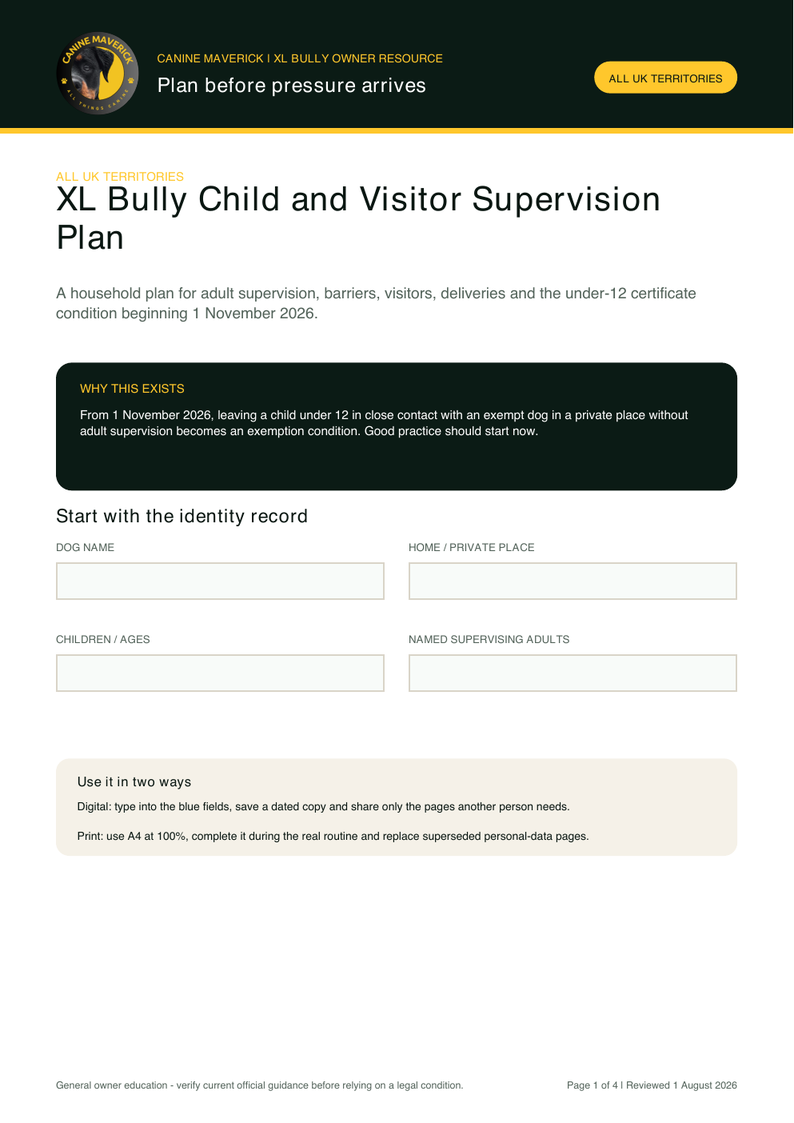
The free XL Bully Child and Visitor Supervision Plan is built for exactly this: it gives you a written household plan you can complete in your browser, save privately on your own device and print for the fridge. Having a written, dated plan also demonstrates that you took the condition seriously, which matters if you are ever asked.
This is a legal condition, not a verdict on your dog
Owners find this rule hard, and often read it as an accusation about their own dog. It is worth separating two things. The legal condition applies regardless of your dog's temperament — a gentle, well-trained, thoroughly socialised XL Bully is covered by it exactly as any other is. Compliance is not an admission that your dog is dangerous.
At the same time, supervision around children is sound practice with any dog of any breed, and the general safety guidance from Blue Cross and Dogs Trust is worth reading on its own merits. Our guides to children and dogs and preventing bites at home cover the body-language signals that matter — and children are most at risk from dogs they know, in homes, which is the situation this condition addresses.
What to do next
- Confirm the current conditions for your jurisdiction on the official page, and note the date you checked.
- Complete the child and visitor supervision plan and put it somewhere everyone sees it.
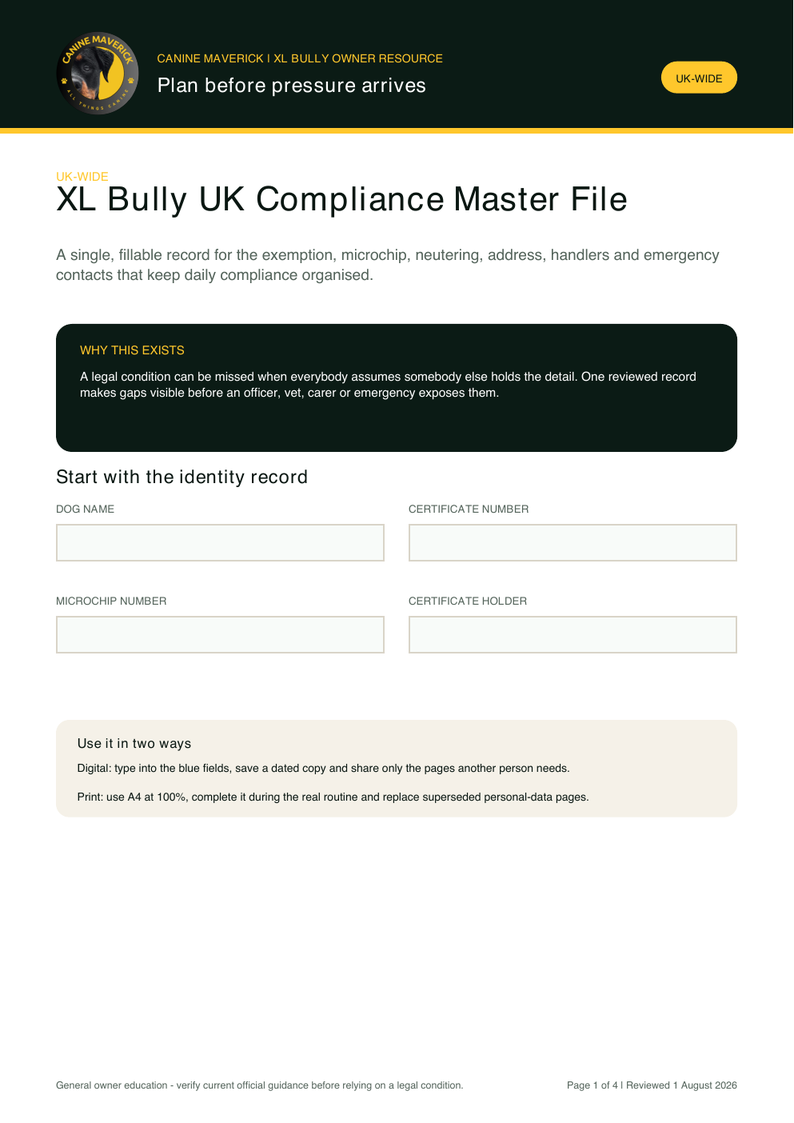
- Review the rest of your compliance using the compliance master file.
- If you think you may already be in breach of any condition, read Certificate of Exemption problems and take advice.
Sources and legislation
Official guidance
- GOV.UK: Ban on XL Bully dogs — England and Wales wording: child under 12, close contact, private place, adult supervision, from 1 November 2026
- nidirect: XL Bully dogs — Northern Ireland wording, in the same terms as England and Wales
- Scottish Government: XL Bully dog rules — exemptions — Scottish wording: adult aged 16 or over must be present, and the condition covers any prohibited type dog
Veterinary and professional bodies
Primary sources checked on . Rules and clinical guidance change; follow the linked organisation for the current position.
How this guide is sourced
Canine Maverick separates the kinds of knowledge behind a page so you can weigh each claim yourself.
| Evidence type | How it is used here |
|---|---|
| Official guidance | Government, regulator or statutory body publications, linked so you can read the primary wording. |
| Owner experience | First-hand observation from more than 30 years of owning, breeding, training and rehoming dogs. |
| Editorial judgement | Canine Maverick’s own synthesis, clearly separated from the sourced material above. |
Frequently asked questions
What exactly is the rule?
Official guidance states that from 1 November 2026 you must not leave a child under 12 in close contact with an XL Bully dog in a private place — for example a home or garden — without adult supervision. It is a condition of exemption, so breaching it puts your exemption and your dog at risk.
Does this mean an XL Bully cannot live with children?
No. The rule is about supervision, not about whether the dog can be in a household with children. What it requires is that an adult is present and supervising when a child under 12 is in close contact with the dog.
Which jurisdictions does it apply to?
All four UK territories, from the same date. The wording differs: England, Wales and Northern Ireland use "close contact" wording with no stated adult age, while Scottish Government guidance states that an adult aged 16 or over must be present and frames the condition around any prohibited type dog rather than XL Bully dogs alone.
What counts as adult supervision?
In Scotland, guidance states an adult aged 16 or over must be present. England, Wales and Northern Ireland do not state a minimum age, so the safe reading is the strict one: an adult present, aware and able to intervene. An adult in another room, asleep, or absorbed in something else is not supervising in any meaningful sense.
Does it apply to visiting children?
The condition refers to a child under 12 in a private place, so plan on the basis that it covers visiting children as well as those who live with you. Visits, parties and family gatherings need a plan made in advance rather than improvised.
What happens if I breach it?
It is a condition of exemption. Breaching exemption conditions can put your certificate and your dog at risk and may result in prosecution. If you think a breach has occurred, take legal advice rather than waiting to see whether anything follows.