Safety & Law
Dangerous Dog Solicitors UK: How to Choose & What to Do First

What this page is for
This page explains when a dog owner in the UK may need specialist legal advice, what tends to happen in the first days of a dog-law case, and how to prepare so that the solicitor you instruct can do their job properly.
Scope: this is legal information, not legal advice, and Canine Maverick does not recommend individual firms. What it does is help you understand the process and arrive at a first appointment organised rather than panicking.
If police or a council officer are involved
What to do first
- Do not delete, edit or “tidy up” evidence. Keep original files and messages.
- Do not sign paperwork you do not understand. Ask what it does and obtain advice where it could affect ownership or the dog’s future.
- Do not argue the case on social media. Public posts can create a second record you cannot control.
- Verify the person you instruct. Use the Law Society or relevant national regulator, then ask about recent dog-law case experience.
When specialist advice is genuinely needed
Not every dog problem is a legal problem. Get specialist advice promptly in any of these situations:
- Your dog has been seized by police or a local authority, for any reason.
- You have been told your dog may be a prohibited type — most commonly an XL Bully, but also a Pit Bull Terrier type.
- You have been invited to a police interview, whether under caution, voluntary, or "just for a chat".
- Your dog has bitten or injured someone, including a household member, a visitor or another person's dog.
- An allegation has been made that your dog was dangerously out of control, even if nobody was hurt.
- You have a problem with a Certificate of Exemption — a refusal, a condition you cannot meet, or a change you failed to report.
- A Community Protection Notice or Dog Control Notice has been served on you.
- Court proceedings have started, or you have received any correspondence mentioning destruction or contingent destruction orders.
The common thread is that all of these can end with an order to destroy the dog. That is why the threshold for getting advice is lower here than in most areas of life.
The first 48 hours
What you do immediately has a disproportionate effect on the outcome, and most of it is about not making things worse.
| Do | Do not |
|---|---|
| Ask for the seizing officer's name, collar number, force and the reference number. | Do not obstruct or argue with officers at the scene. |
| Ask in writing where the dog is being kennelled and how its welfare needs will be met. | Do not assume you will be told these things without asking. |
| If you are asked to attend an interview, including a voluntary one, consider taking specialist legal advice first. | Try not to give a detailed account of the incident before you have taken advice, particularly where an offence may be alleged. Cooperating with urgent welfare questions about your dog is a different matter. |
| Tell the police about medical needs, medication and diet for your dog immediately. | Where you are asked to sign a disclaimer, ownership document or other formal paperwork affecting your dog, consider taking advice before deciding whether to sign. |
| Write your own account of events while it is fresh, dated, for your solicitor. | Do not post anything online, in any group, public or private. |
| Preserve everything: photos, video, vet records, messages, witness details. | Do not delete anything, even if it looks unhelpful to you. |
What happens after a dog is seized
Broadly, a seized dog is kennelled at a facility contracted to the police, an expert assesses whether it meets the description of a prohibited type, and the case proceeds either as a prosecution or as an application about the dog. Several features of this routinely surprise owners:
- It takes a long time. Months is normal. During that time you will usually not be allowed to visit.
- Type is assessed on physical measurements and characteristics, not DNA or pedigree. A dog with papers for another breed can still be found to be of type.
- Kennelling costs accumulate, and you may be asked to pay them.
- A finding that a dog is of type is not automatically the end. A court can order that the dog be added to the Index of Exempted Dogs if satisfied it does not pose a danger to public safety and there is a fit and proper person to keep it.
Our detailed guide to what happens if an XL Bully is seized covers this process step by step, and what to do when police say your dog is an XL Bully deals with the type-assessment question specifically.
Dangerous-dog allegations
Section 3 prosecutions catch owners out because the test is lower than most people assume. The offence concerns a dog being dangerously out of control, which includes circumstances giving grounds for reasonable apprehension that it would injure a person — no bite is required. Since 2014 it applies on private property too, including your own home, with limited exceptions relating to trespassers.
We explain the test and how it is applied in what "dangerously out of control" actually means. If an incident has already happened, what happens after a dog bite or dog incident sets out the sequence.
Preserving evidence
Evidence disappears quickly, and almost all of the useful material is in your hands rather than anyone else's. Preserve it now, before you know whether you will need it:
- Photographs and video of the location, sightlines, gates, fencing, signage and lighting — conditions change.
- Doorbell and CCTV footage, downloaded and backed up. Most systems overwrite within days.
- Your dog's full veterinary history, including any behavioural notes and its temperament in the clinic.
- Training records: classes attended, trainer or behaviourist details, certificates.
- Insurance documents and your policy's legal-expenses section.
- Witness names and contact details, gathered immediately.
- Messages and correspondence with anyone involved, unedited.
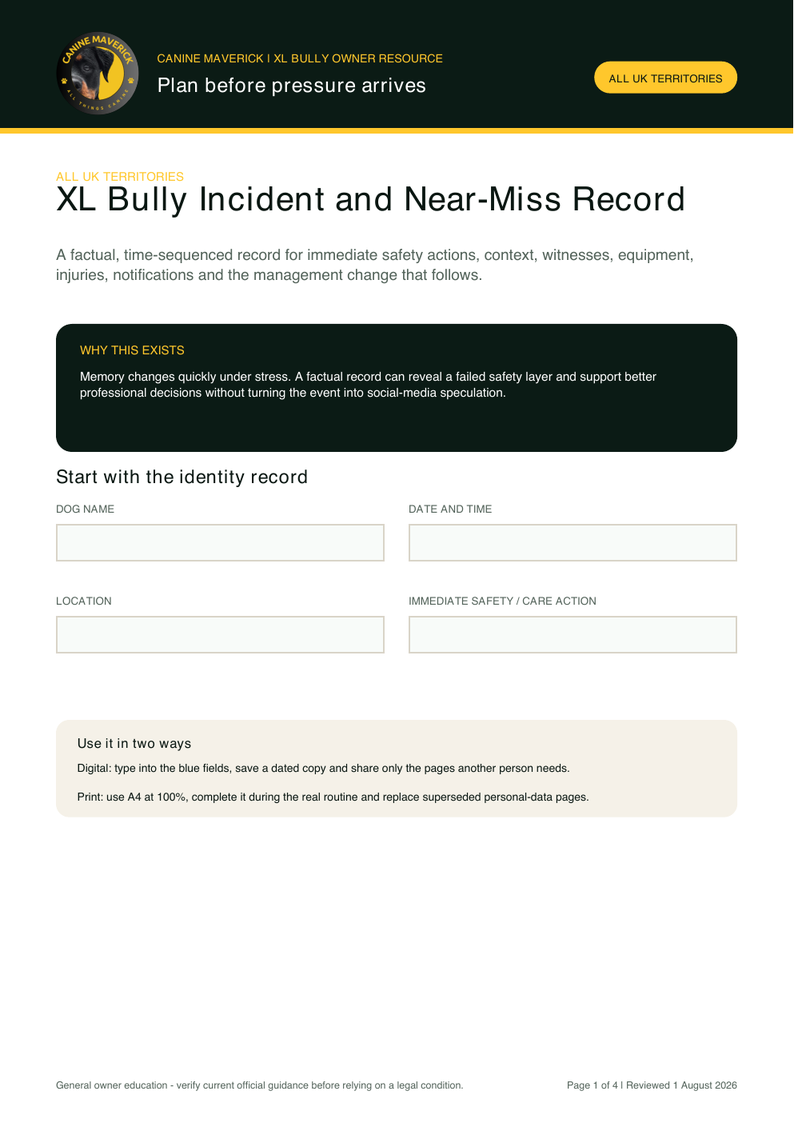
- A dated written account of the incident in your own words, written as soon as possible.
Our Dog Incident Documentation Toolkit gives you a structured place to record all of this. It works in your browser and nothing is sent to us.
What not to post publicly
This is the advice owners most often ignore and most often regret. Anything you publish can be obtained and produced in evidence — including posts you delete, comments in closed Facebook groups, and messages to people you trust.
The categories worth being most careful with are: your account of the incident; photographs or video of your dog, especially anything showing it off-lead, unmuzzled or with children; criticism of the complainant, the police or the council; fundraising appeals describing the case; and anything about what you have told or intend to tell the police. It is worth asking friends and family not to post on your behalf either — a supportive relative's post can carry the same weight as your own. Where you are unsure, your solicitor is the right person to ask before publishing.
Questions to ask a solicitor
You are entitled to ask all of these before you instruct anyone, and a good firm will not mind:
- How many dog-law cases have you personally handled in the last two years, and how many involved seized dogs?
- Have you dealt with section 1 type cases as well as section 3 prosecutions?
- Who will actually run my case day to day, and what is their experience?
- Which expert witnesses do you use for type assessment or behavioural evidence, and who pays for them?
- What is your view of the realistic range of outcomes here?
- What will this cost — and what happens if it takes longer than expected?
- Am I eligible for legal aid, or does my insurance include legal expenses cover?
- Who is liable for kennelling costs, and can anything be done to limit them?
- What should I be doing right now, and what should I stop doing?
- How quickly will you respond if something changes?
Bring your records to that first meeting. Preparing records for a dog-law solicitor sets out exactly what to assemble and in what order.
Finding and checking a solicitor
Canine Maverick does not recommend individual firms. We have no verified basis for ranking dog-law solicitors, and a page that took referral fees for doing so would not be worth reading. What we can tell you is how to check that whoever you are considering is real, regulated and appropriate.
- England and Wales — verify on the Law Society's Find a Solicitor register.
- Scotland — verify with the Law Society of Scotland.
- Northern Ireland — verify with the Law Society of Northern Ireland.
Jurisdiction matters more than owners expect. The Dangerous Dogs Act 1991 applies across England, Wales and Scotland, but procedure, prosecuting authorities and sentencing practice differ, and Scotland has its own separate framework including Dog Control Notices. Northern Ireland has its own legislation and licensing system. Instruct someone qualified in the jurisdiction where the matter is being dealt with.
Two practical warnings. Be cautious about any firm guaranteeing an outcome — nobody can. And be cautious about advice from campaign groups or social media, however well-meaning: it is frequently out of date, frequently about a different jurisdiction, and it is not a substitute for someone who is professionally accountable to you.
Cost and funding
Ask about all of these early, because they change what is realistic:
- Legal aid may be available for criminal proceedings, subject to means and merits. Ask at first contact.
- Legal-expenses insurance is often included in home or pet insurance and forgotten. Check the policy before you assume you are self-funding.
- Kennelling costs can exceed legal costs in a long case. Ask how they are handled.
- Expert witness fees are usually separate from the solicitor's fees.
What to do next
If your dog has been seized or you have been contacted by police, stop reading and phone a solicitor. If you are preparing rather than reacting, the useful next steps are to assemble your records using the incident documentation toolkit, read what "dangerously out of control" means so you understand the test, and — if you own an affected breed — work through the current rules in the UK XL Bully rules comparison.
Sources and legislation
Legislation and official guidance
- Dangerous Dogs Act 1991 — the primary statute, including section 1 (prohibited types) and section 3 (dangerously out of control)
- Anti-social Behaviour, Crime and Policing Act 2014 — amended the 1991 Act, including extending section 3 to private property
Official guidance
- GOV.UK: Controlling your dog in public
- GOV.UK: Banned dogs
- GOV.UK: Ban on XL Bully dogs
- The Law Society: Find a Solicitor — the regulated register for England and Wales
- Law Society of Scotland: Find a solicitor
- Law Society of Northern Ireland: solicitor search
- GOV.UK: Legal aid
Primary sources checked on . Rules and clinical guidance change; follow the linked organisation for the current position.
How this guide is sourced
Canine Maverick separates the kinds of knowledge behind a page so you can weigh each claim yourself.
| Evidence type | How it is used here |
|---|---|
| Official guidance | Government, regulator or statutory body publications, linked so you can read the primary wording. |
| Professional guidance | Veterinary, accredited behaviour or legal expertise published by a recognised body. |
| Editorial judgement | Canine Maverick’s own synthesis, clearly separated from the sourced material above. |
Frequently asked questions
Do I need a specialist dog-law solicitor, or will any solicitor do?
For anything involving seizure, a section 1 type allegation or a section 3 prosecution, experience matters a great deal. Dog law is a narrow field with its own case law, its own expert witnesses and its own procedural traps. A competent general criminal solicitor can represent you, but one who regularly handles dog cases will know the arguments that work and the evidence that is worth gathering.
The police have taken my dog. Can I get it back straight away?
Usually not immediately. Where a dog is seized it is commonly held in kennels while the case proceeds, which can take months. Whether an interim release is possible depends on the circumstances and the force involved. This is one of the first things to raise with a solicitor, because the dog’s welfare in kennels and the eventual kennelling costs are both significant.
Can I be prosecuted if my dog did not bite anyone?
Yes. Under section 3 of the Dangerous Dogs Act 1991 the offence is a dog being dangerously out of control, which includes grounds for reasonable apprehension that it would injure someone — an actual injury is not required. Since 2014 this also applies on private property, including your own home.
Is legal aid available?
It may be, depending on the type of proceedings, your means and where you live. Criminal proceedings are more likely to qualify than civil ones. Ask about funding at the first contact, and ask specifically what happens to costs if the case runs longer than expected.
Should I post about it online?
It is generally wise not to. Anything you publish can be obtained and produced in evidence, including posts you later delete and comments in private groups — descriptions of the incident, photographs of your dog, and criticism of the complainant or the police. Where proceedings are possible, discussing what to publish with your solicitor first is a sensible precaution.
How do I check a solicitor is genuinely regulated?
Use the official register for the relevant jurisdiction — the Law Society Find a Solicitor service for England and Wales, the Law Society of Scotland, or the Law Society of Northern Ireland. A firm’s own website is not verification.