Safety & Law
Dangerous Dogs Law in the UK: What Every Owner Must Understand
My answer first
I wrote this guide to give owners a practical starting point: A practical Canine Maverick guide to the practical meaning of a dog being dangerously out of control and the owner’s responsibilities.
My scope: I am sharing general owner education from my experience. I am not diagnosing an individual dog or replacing veterinary, behaviour or legal advice.
The law is wider than banned types
My starting point is simple. UK dog law can apply when any dog is dangerously out of control, and separate rules apply to prohibited types. Territory and exemption details can change. Use current government guidance rather than social-media summaries, and obtain legal advice for an individual case.
Control applies in public and private places
This is the order I would work through:
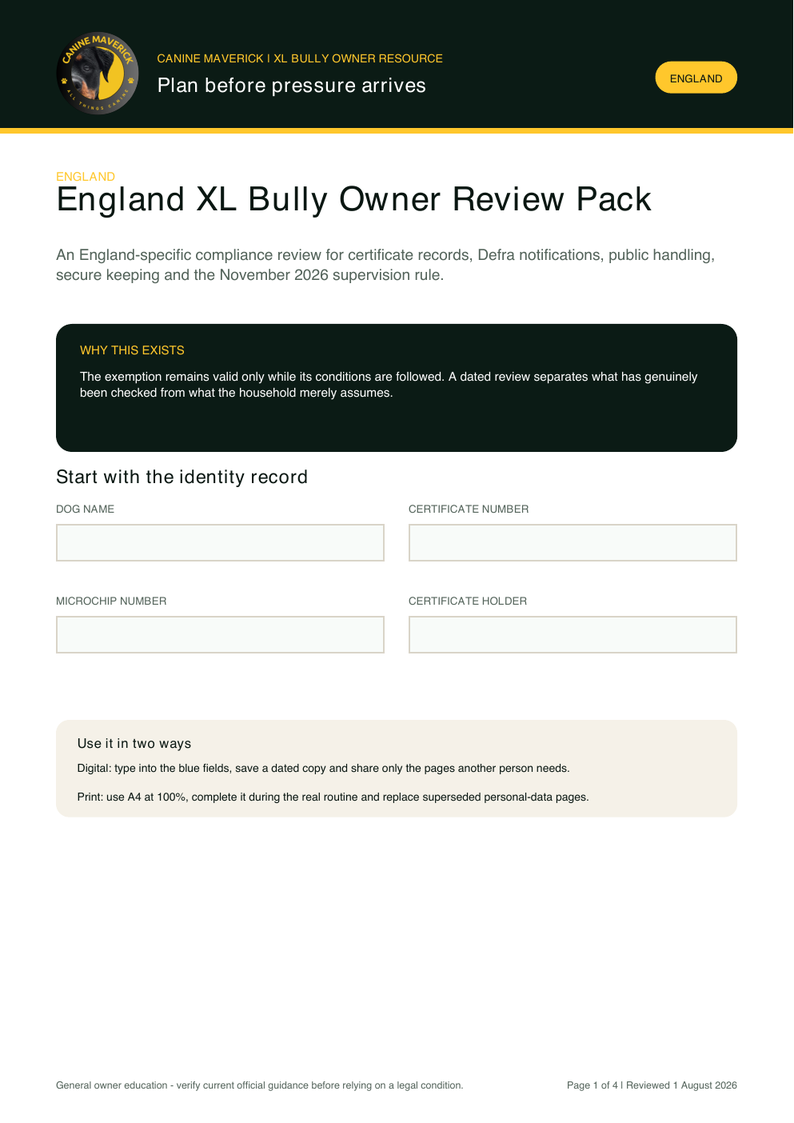
- Identify which UK territory’s rules apply.
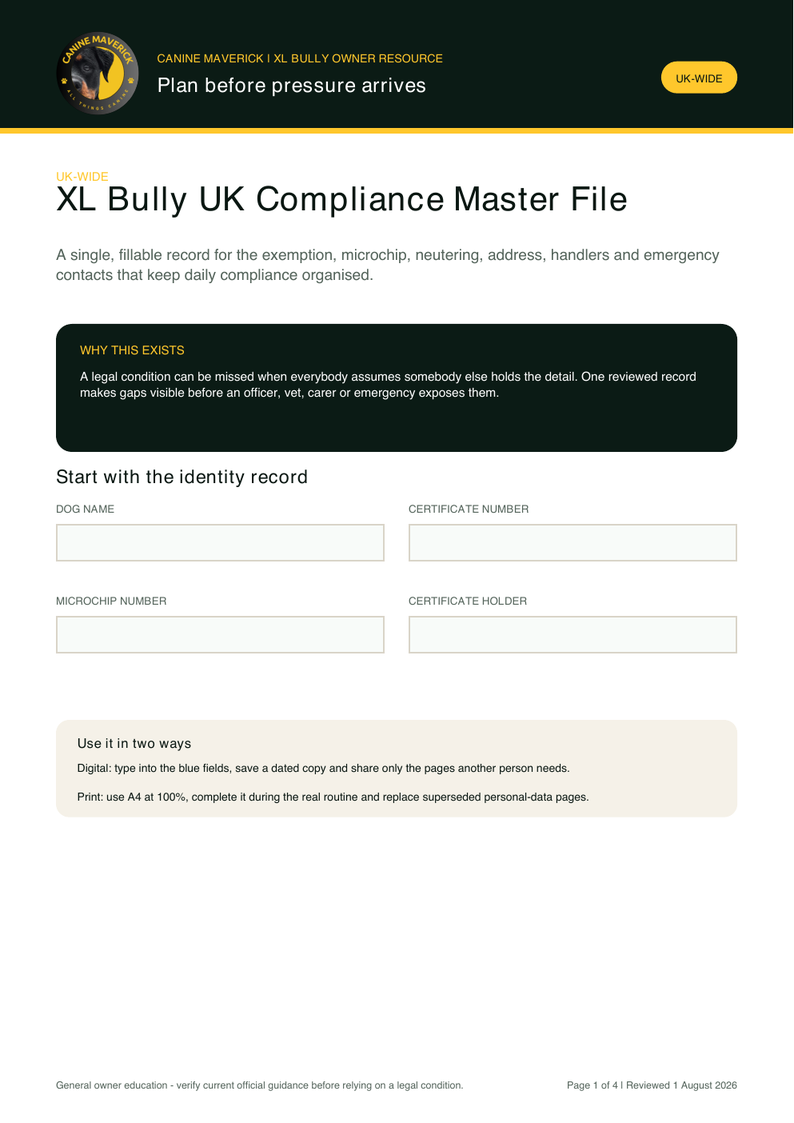
- Keep microchip, insurance and exemption records together where relevant.
- Check lead, muzzle and public-place conditions before travel.
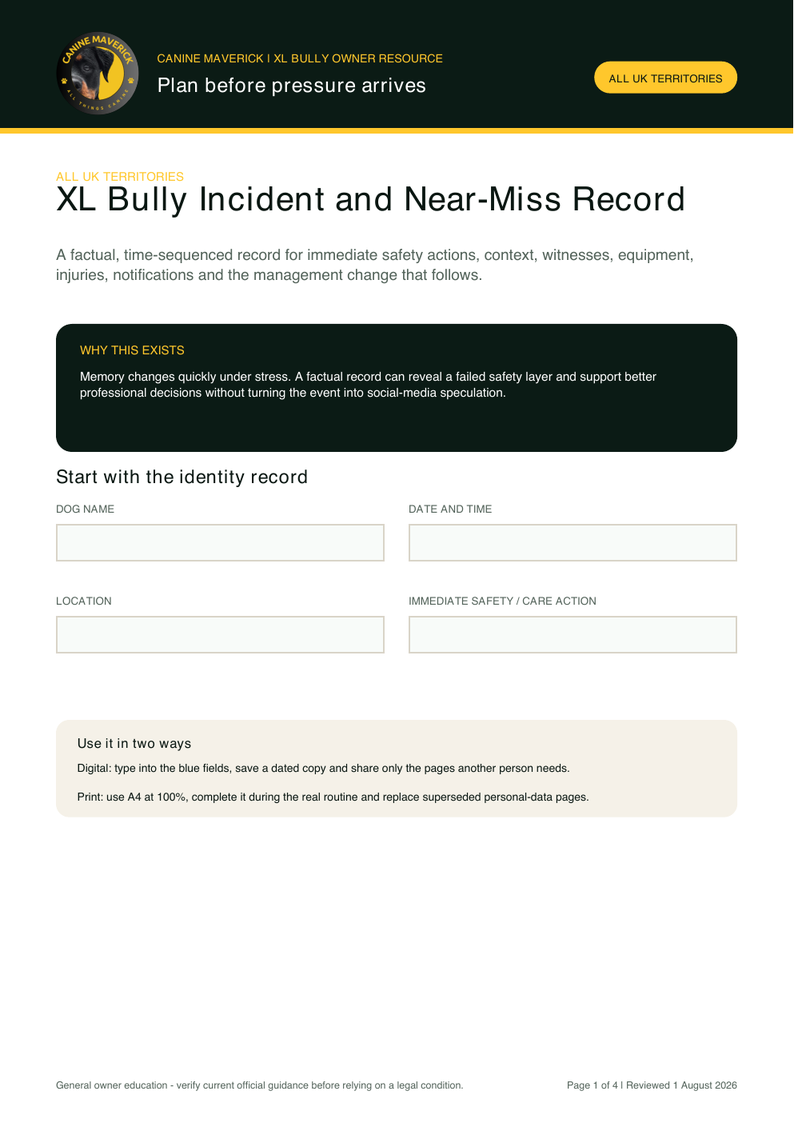
- Record incidents and seek legal advice rather than arguing the case online.
Use official territory guidance
I use the dog’s response and the level of risk—not pride, pressure or a fixed timetable—to choose my next step.
| What I notice | What I would do next |
|---|---|
| General concern about control | Improve management and training before an incident. |
| Dog may meet a prohibited-type definition | Use official conformation guidance and obtain individual legal advice. |
| Police, council or court contact received | Preserve documents and contact a solicitor promptly. |
Prepare records before they are requested
Mistakes I would avoid
- Relying on breed labels alone
- Assuming private property removes liability
- Missing renewal or address requirements
- Posting case details publicly before advice
Build a safety system that does not depend on luck
I treat the subject of “Dangerous Dogs Law in the UK: What Every Owner Must Understand” as a layered safety problem. Training is one layer, but doors, gates, distance, equipment, written handovers and adult supervision do the immediate prevention work. Identify which UK territory’s rules apply. I ask what happens if one layer fails: if a clip opens, a visitor ignores the sign or the usual handler is unavailable. Adding a second sensible barrier is not overreacting; it is how I reduce the consequence of an ordinary human mistake.
A realistic example
A practical example is an unexpected visitor. I do not try to train while the doorbell is ringing and everyone is talking. I move the dog behind the planned barrier, give the visitor instructions and only consider a controlled introduction if the dog, handler and environment are genuinely ready. Keep microchip, insurance and exemption records together where relevant. If the plan cannot be followed by another competent adult, I simplify it and write it down.
What I record and why
I log triggers, distance, body language, equipment, handler and recovery. The early sign may be general concern about control; in that situation, improve management and training before an incident. Near misses count as information even when nobody was hurt. I review them while the details are fresh and change the environment before the same chain of events can repeat.
My seven-day reset
For “Dangerous Dogs Law in the UK: What Every Owner Must Understand”, I use a week as a review window, not as a promise that the issue will be solved in seven days. The aim is to replace guesswork with a calm baseline and a repeatable next step.
- Day 1: Write down the baseline for “Dangerous Dogs Law in the UK: What Every Owner Must Understand” before changing anything.
- Day 2: Identify which UK territory’s rules apply.
- Day 3: Repeat the easiest useful step and finish while the dog is coping.
- Day 4: Review the environment, timing and every person involved.
- Day 5: Keep microchip, insurance and exemption records together where relevant.
- Day 6: Check lead, muzzle and public-place conditions before travel.
- Day 7: Compare the week with the baseline and choose one next adjustment.
How I keep the advice safe
While applying “Dangerous Dogs Law in the UK: What Every Owner Must Understand”, I stop if the dog becomes distressed, painful, unusually quiet, unable to recover or unsafe to handle. I do not use a website article to diagnose disease, settle a legal case or design an individual behaviour programme. I use it to prepare better questions, improve immediate management and recognise when my vet, an appropriately qualified behaviour professional or a solicitor needs to see the individual facts.
The questions I use before changing the plan
I keep my review of “Dangerous Dogs Law in the UK: What Every Owner Must Understand” specific to the dog in front of me. My first practical anchor is: Identify which UK territory’s rules apply. From there I compare the response with the original baseline, not with somebody else’s highlight reel. If general concern about control, I would improve management and training before an incident. I also look for unintended effects: a plan that improves one behaviour while increasing fear, pain or household risk is not a successful plan.
- Which layer prevented an incident?
- What could have failed?
- Did every adult follow the same handover?
- What was the earliest warning sign?
- Which physical safeguard will I improve now?
I share my notes from “Dangerous Dogs Law in the UK: What Every Owner Must Understand” with the relevant professional when the issue is medical, legally sensitive or carries a realistic risk to people or animals. Clear dates, short descriptions and photographs or video—taken only when safe—help another person understand the sequence. They also stop me quietly rewriting the story after a good or bad day. That honesty is central to how I want Canine Maverick guidance to work.
Sources I checked and further reading
I checked these sources on 1 August 2026. Product availability, law and professional guidance can change, so I always follow the linked source for current details.
Sláinte,
Conor